

The Quantstamp Blog


Quantstamp Announcements
Ethereum 2.0 Moves Closer to Launch with Quantstamp Audit of Prysm
Quantstamp recently has completed its audit of Ethereum 2.0 as implemented by Prysmatic Labs.

Quantstamp Announcements
Ethereum Gas Fees Are High, But SKALE Network Has a Solution
Gas fees are consistently rising which creates user experience issues for potential dApp use cases. Luckily, SKALE Network has an innovative scaling solution with elastic sidechains.

Quantstamp Announcements
Quantstamp Presents Tech Talk at Facebook Headquarters on Blockchain Security
Thanks Facebook HQ for hosting us today for a great conversation about Ethereum, smart contracts and security.
Quantstamp Labs
4 Myths about Ethereum 2.0
Ethereum 2.0, a long-awaited upgrade to Ethereum, is planning to be launched this year. More than a simple update or hard fork, it is an entirely new blockchain which runs on a Proof-of-Stake system. There’s a lot of talk and speculation about Ethereum 2.0. In this post, we highlight 5 easily held misconceptions about this next stage of Ethereum.
Quantstamp Labs
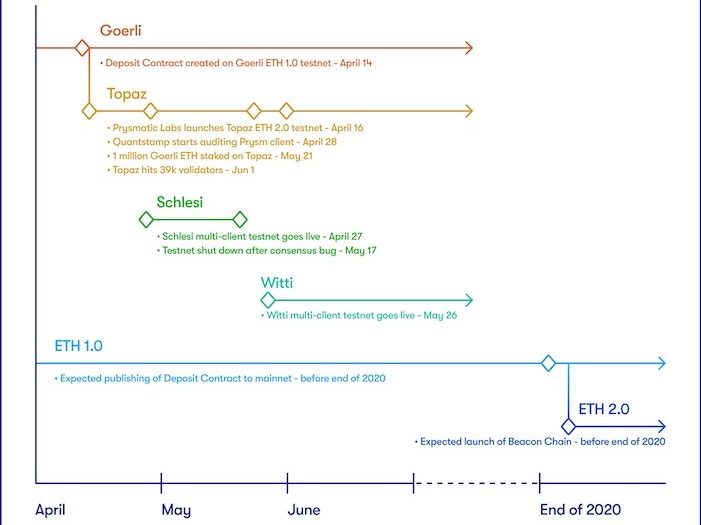
Understanding Phase 0, The Current Stage of ETH 2.0 Development
Most information about ETH 2.0 development is either highly technical or excessively general. We wrote this post to clear up any confusion regarding the status of ETH 2.0 development.

Quantstamp Announcements
How to Be an ETH 2.0 Validator on the Topaz Testnet
The Topaz Testnet is a public Ethereum 2.0 testnet created by Prysmatic Labs. It is a testnet version of Ethereum 2.0 Phase 0 which is planned to launch on mainnet later this year. Anyone can participate in the Topaz Testnet as a validator, and this article will walk you through the process.

Quantstamp Announcements
Smart Contract Audit Cost
Quantstamp conducted over 120 audits and secured 2 billion USD worth of digital assets since we were founded in 2017. The purpose of this post is to explain the audit pricing process for potential clients.

Quantstamp Labs
Securing Your DeFi Project Starts with Quality Testing
Tests are undervalued. Quantstamp secured over 2 billion USD worth of digital assets since 2017. Through our experience securing smart contracts, we noticed that developers highly underestimate the importance of test suites.
Quantstamp Announcements
How the dForce hacker used reentrancy to steal 25 million
The hacker exploited a reentrancy vulnerability in order to manipulate Lendf.Me’s internal record of the hacker's collateral. After the hacker created this false collateral record, the hacker withdrew nearly all assets from the platform.